🔬 Science · 30 missions

Science for grades 1–5, at a top-school standard

From living things and weather in 1st grade to ecosystems, the solar system and fair tests in 5th, SparkQuest's science missions teach kids to reason like scientists: predicting what will happen, explaining evidence and untangling cause and effect, not just memorizing facts. Genius questions are modeled on science competitions.

1st grade science

Science6 missions

  • Living ThingsWhat makes something alive?Free
  • Animal GroupsMammals, birds, fish, and moreFree
  • Super SensesSee, hear, smell, taste, touch
  • Weather & SeasonsSun, rain, snow, and wind
  • Sun, Moon & StarsWhat we see in the sky
  • Sound & LightVibrations, echoes, and shadows

Boss battle: 🦠 Germy the Blob

Everything in 1st grade →
Where it starts⭐ Explorer🔬 Animal Groups

Why is a dolphin a mammal and not a fish?

  • It swims fast in the deep ocean
  • It breathes air and feeds its babies milk
  • It has smooth fins and a strong tail
  • It catches and eats other fish
Show the answer and explanation ↓

Answer: It breathes air and feeds its babies milk

  1. 1Lots of fish swim, have fins, and eat other fish too.
  2. 2But dolphins breathe air with lungs and feed their babies milk.
  3. 3Those are mammal traits, so a dolphin is a mammal!
How far it goes💎 Genius🔬 Sound & Light

An alarm clock rings inside a glass jar. A pump slowly sucks the air out of the jar. What do you hear?

  • The ringing stays exactly the same
  • The ringing turns into a bright glow
  • The ringing gets louder and louder
  • The ringing gets quieter and quieter
Show the answer and explanation ↓

Answer: The ringing gets quieter and quieter

  1. 1The bell still shakes, but sound needs something to travel through.
  2. 2At first, air carries the vibrations to the glass and out to you.
  3. 3As the air is pumped out, there is less to carry the sound.
  4. 4So the ringing fades, even though you can still SEE the hammer moving!

2nd grade science

Science6 missions

  • Plant PowerRoots, stems, leaves, and seedsFree
  • Bug WorldInsects, spiders, and pollinatorsFree
  • Animal HabitatsWhere animals live and why
  • Solids, Liquids & GasesStates of matter
  • Material ScientistsProperties and changes of materials
  • Land & WaterMountains, rivers, oceans, and maps

Boss battle: 🌪️ Twisty Tornado

Everything in 2nd grade →
Where it starts⭐ Explorer🔬 Bug World

Why do some moths have big round “eye” spots on their wings?

  • To soak up more warm sunlight
  • To scare predators by looking like big eyes
  • To help them see what is behind them
  • To glow brightly in the dark at night
Show the answer and explanation ↓

Answer: To scare predators by looking like big eyes

  1. 1The spots are just colors, not real eyes.
  2. 2To a bird, they can look like the eyes of a big animal.
  3. 3That can scare the bird away and keep the moth safe!
How far it goes💎 Genius🔬 Land & Water

Kids build two sand hills in trays: one steep, one gentle. They pour the same amount of water on each. The steep hill loses 9 spoonfuls of sand; the gentle hill loses 2. What does this show?

  • Water running down steep slopes carries away more soil
  • Gentle hills soak up every drop of water
  • Steep hills are made of softer sand
  • Water flows uphill on gentle slopes
Show the answer and explanation ↓

Answer: Water running down steep slopes carries away more soil

  1. 1The sand and water were the same, so the slope is the only difference.
  2. 2On the steep hill, the water rushed down fast.
  3. 3Fast water carries away more sand.
  4. 4So steep slopes erode faster! That is why hill farmers build flat steps called terraces.

3rd grade science

Science6 missions

  • Life CyclesHow living things grow and changeFree
  • Family TraitsInherited and learned traitsFree
  • Survival SkillsHow living things adapt
  • Fossil HuntersClues from long ago
  • Forces & MagnetsPush, pull, gravity, and friction
  • Weather ScientistsWater cycle, weather, and climate

Boss battle: 🌋 Magma Monster

Everything in 3rd grade →
Where it starts⭐ Explorer🔬 Family Traits

Why is it helpful when animals in a group have different traits (variation)?

  • It makes every animal exactly alike
  • Some may survive if the environment changes
  • It means none of them need food
  • It stops the environment from changing
Show the answer and explanation ↓

Answer: Some may survive if the environment changes

  1. 1Environments change: new diseases, new predators, colder winters.
  2. 2If every animal were exactly alike, one change could wipe out the whole group.
  3. 3With variation, some animals may have just the right traits to survive!
How far it goes💎 Genius🔬 Weather Scientists

You see lightning and count 15 seconds until the thunder. Ten minutes later, you count only 10 seconds. Sound travels about 1 mile every 5 seconds. What is happening?

  • The storm stayed exactly 3 miles away
  • The storm moved closer: from 15 miles to 10 miles away
  • The storm moved closer: from 3 miles to 2 miles away
  • The storm moved away: from 2 miles to 3 miles away
Show the answer and explanation ↓

Answer: The storm moved closer: from 3 miles to 2 miles away

  1. 1Light reaches you almost instantly, but sound takes time.
  2. 2First flash: 15 ÷ 5 = 3 miles away. Second flash: 10 ÷ 5 = 2 miles away.
  3. 3A shorter wait means the lightning is closer.
  4. 4The storm is coming toward you. Time to head indoors!

4th grade science

Science6 missions

  • Energy ExplorersMotion, heat, light, and electricityFree
  • Light & WavesReflection, refraction, and wavesFree
  • Energy & Earth's ResourcesFuels, hazards, and saving energy
  • Human BodyOrgans and how they work
  • Inside Living ThingsStructures that help survival
  • Earth's SurfaceRocks, erosion, and earthquakes

Boss battle: ⚡ Volt Viper

Everything in 4th grade →
Where it starts⭐ Explorer🔬 Light & Waves

Why can you HEAR a friend around a corner but not SEE them?

  • Sound travels faster than light
  • Sound waves spread around corners more than light
  • Your eyes are closed around corners
  • Light cannot travel through air
Show the answer and explanation ↓

Answer: Sound waves spread around corners more than light

  1. 1Light mostly travels in straight lines, so walls block your view.
  2. 2Sound waves spread out and bend around corners and doorways.
  3. 3That is why you can hear someone you cannot see!
How far it goes💎 Genius🔬 Earth's Surface

Huge boulders sit on flat farmland, made of a rock that is found only far to the north. Long scratches on the bedrock beneath them all run north–south. What is the best explanation?

  • A volcano threw the boulders from far away
  • A glacier carried them south and scratched the bedrock
  • A river rolled the boulders across the land
  • Farmers piled the boulders and scratched the rock
Show the answer and explanation ↓

Answer: A glacier carried them south and scratched the bedrock

  1. 1The boulders don’t match the local rock, so something carried them a long way from the north.
  2. 2A river on flat land is far too slow and gentle to roll boulders that big.
  3. 3A glacier can carry giant rocks frozen in its ice, and rocks dragged along its bottom scratch long lines into the bedrock.
  4. 4The scratches line up with the glacier’s path!

5th grade science

Science6 missions

  • Matter & MixturesAtoms, solutions, and changesFree
  • Earth's SystemsGeosphere, hydrosphere, and moreFree
  • Ecosystems & Food ChainsProducers, consumers, decomposers
  • Space & Solar SystemPlanets, stars, and the Moon
  • Shadows, Stars & SeasonsPatterns in the sky
  • Think Like a ScientistExperiments and fair tests

Boss battle: ☄️ Comet King

Everything in 5th grade →
Where it starts⭐ Explorer🔬 Earth's Systems

Earth is mostly covered with water. So why does fixing a leaky faucet still matter?

  • Leaks make the oceans overflow
  • Faucet water turns into salt water
  • Clean, usable fresh water is limited
  • Dripping water can never evaporate
Show the answer and explanation ↓

Answer: Clean, usable fresh water is limited

  1. 1Most of Earth’s water is salty or frozen.
  2. 2Only a tiny share is fresh water we can easily use, and it must be cleaned and pumped to homes.
  3. 3Wasting it wastes a limited resource, so fixing leaks matters!
How far it goes💎 Genius🔬 Think Like a Scientist

A distance–time graph for a snail: a straight line from 0 cm at 0 min to 30 cm at 10 min; a flat line from 10 to 15 min; then a straight line up to 50 cm at 20 min. When was the snail moving FASTEST?

  • At the same speed the whole time
  • From 10 to 15 minutes
  • From 0 to 10 minutes
  • From 15 to 20 minutes
Show the answer and explanation ↓

Answer: From 15 to 20 minutes

  1. 1Speed = distance ÷ time for each part.
  2. 20 to 10 min: 30 cm ÷ 10 min = 3 cm per minute.
  3. 310 to 15 min: a flat line means 0 cm per minute, so the snail rested.
  4. 415 to 20 min: 20 cm ÷ 5 min = 4 cm per minute, the fastest. On this kind of graph, the steepest part is the fastest!

Four levels in every mission

Two right answers in a row move your child up a level, and two misses move them back down, so practice stays hard enough to stretch them without becoming discouraging.

  1. Level 0

    🌱 Warm-up

    Rebuilds the foundations when a skill is shaky.

  2. Level 1

    ⭐ Explorer

    Grade level at a top school, where every mission starts.

  3. Level 2

    🚀 Challenger

    Advanced questions beyond grade level.

  4. Level 3

    💎 Genius

    Competition-level puzzles. Mastering a mission takes Genius.

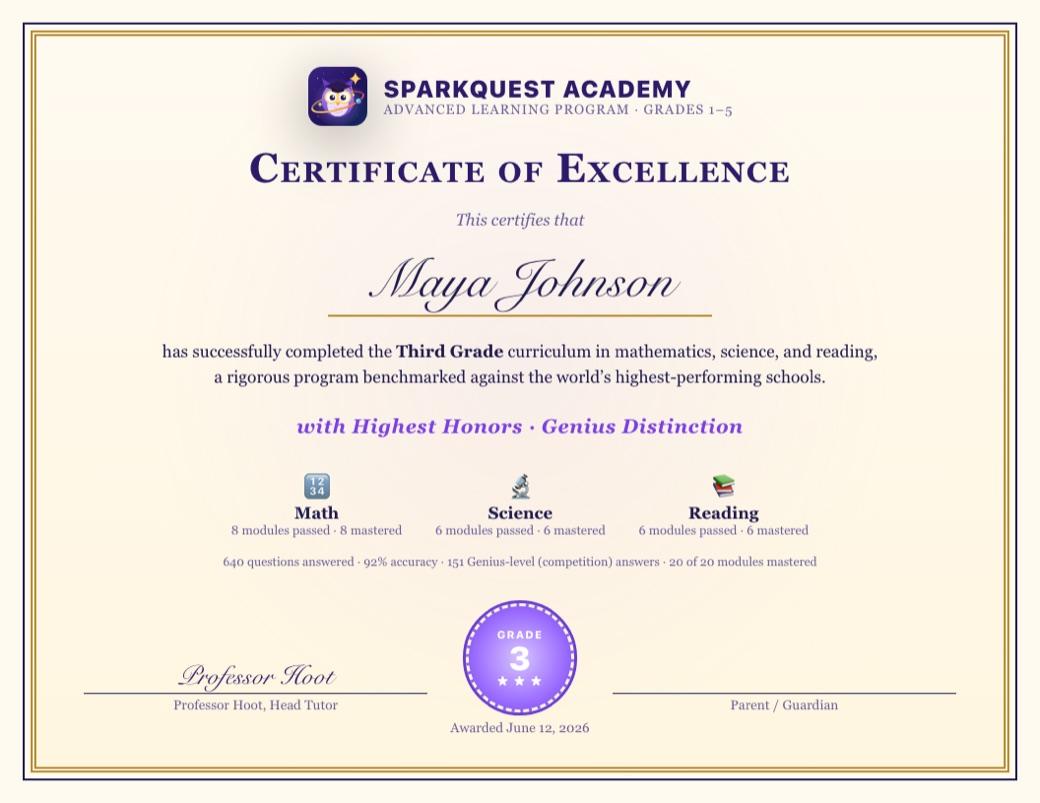
A sample SparkQuest grade certificate with Highest Honors

A certificate for every grade

When your child passes every mission in a grade, you can print a certificate from the Parent Dashboard or save it as a PDF. Passing takes 80% or better on the latest 20 questions, so a certificate means something.

  • ✓ Certificate of Completion for passing every mission
  • ✓ Honors when half the grade's missions are mastered at Genius level
  • ✓ Highest Honors when all of them are

Try it free. Unlock everything once.

30 missions are free forever. The Full Adventure unlocks all 100 missions in every grade for $39 once, shared by every child in your family on up to 3 computers. No subscription, no ads.

Explore the curriculum